New Delhi’s push towards a greener future is gaining global attention. Union Minister for New and Renewable Energy Prahlad Joshi announced that India presents a massive $300 billion investment opportunity in renewable energy production, storage, green hydrogen, grid infrastructure, and manufacturing by 2030.
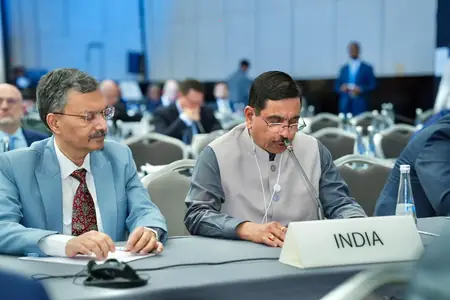
Speaking at the 16th Assembly of the International Renewable Energy Agency (IRENA) in Abu Dhabi, United Arab Emirates, Joshi highlighted India’s stable policies and transparent market mechanisms that position it as one of the world’s most attractive destinations for clean energy investments.
He emphasized the critical need for international collaboration, including technology transfer, affordable financing, capacity building, and harmonization of standards. These efforts will enable developing nations to rapidly adopt renewables without compromising growth.
India stands ready to share its experiences, institutions, and technical expertise with the agency. The minister particularly underscored partnerships with least developed countries and small island developing states to accelerate the global renewable energy transition.
India’s energy transformation transcends mere capacity addition; it’s about empowering people, creating opportunities, and building a shared sustainable future. Anchored in the philosophy of ‘Vasudhaiva Kutumbakam’—one earth, one family, one future—this approach promotes equity, inclusion, and long-term stable policies.
Reaffirming commitments, Joshi reiterated India’s goals of 500 GW non-fossil fuel capacity by 2030 and net-zero emissions by 2070. A landmark achievement: India met 50% of its installed power capacity from non-fossil sources by 2025, five years ahead of the Paris Agreement schedule. Renewable capacity now exceeds 266 GW, placing India among global leaders.
As one of the world’s fastest-growing energy markets, India prioritizes reliable power supply through energy storage solutions, grid modernization, green energy corridors, and round-the-clock power projects. Domestic manufacturing in solar, wind, batteries, and electrolyzers is being boosted for self-reliance and resilient global supply chains.
Connecting transformation to the people, key schemes like PM Surya Ghar Muft Bijli Yojana have solarized rooftops for 2.5 million homes in under two years, aiming for 10 million by March 2027. PM-KUSUM has benefited 2.17 million farmers with solar pumps replacing diesel ones and solarization of agricultural feeders.
Earlier, Joshi participated in a high-level dialogue on ‘Reimagining Energy Futures: Bold Thinking for Shared Prosperity,’ stressing people-centric transitions with international cooperation in finance, technology, and governance.
He congratulated the Dominican Republic on assuming IRENA’s presidency and extended best wishes to vice-presidents Kenya, Solomon Islands, Spain, and Antigua and Barbuda, expressing confidence in their leadership for multilateral collaboration and inclusive global energy shifts.
In a bilateral meeting with UAE’s Minister of Climate Change and Environment Amna bint Abdullah Al Dahak, discussions focused on strengthening ties in climate action, clean energy, and food security. Reviewing partnerships since 2014, emphasis was on renewables, decentralized solutions, manufacturing, storage, tech cooperation, and blended finance to ensure secure, sustainable energy for all.