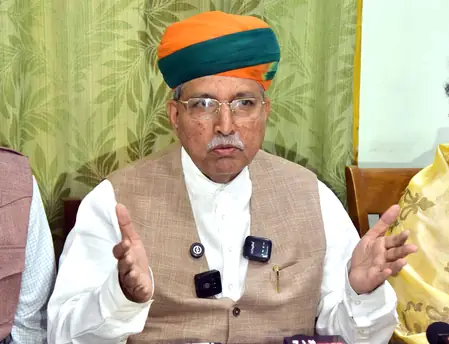
In a sharp political exchange, Union Minister Arjun Ram Meghwal has launched a blistering attack on Rahul Gandhi, accusing the Congress party of surviving solely on appeasement politics. Speaking at a recent public rally, Meghwal declared that the grand old party has made minority appeasement its lifeline, sidelining national interests for electoral gains.
Meghwal, a prominent BJP leader and Minister of State for Finance, didn’t hold back in his criticism. ‘Congress lives only on appeasement,’ he thundered, pointing to the party’s alleged history of prioritizing vote-bank politics over development and security. He specifically targeted Rahul Gandhi, the Leader of Opposition, for continuing this legacy of divisive strategies that he claims have weakened India’s unity.
The remarks come amid escalating tensions between the ruling BJP and opposition Congress ahead of key state elections. Meghwal highlighted how Congress’s policies have repeatedly favored certain communities at the expense of the majority, citing examples from past governance where he alleges corruption and inefficiency flourished under the guise of secularism.
Drawing from his own roots in Rajasthan, Meghwal emphasized the BJP’s commitment to ‘Sabka Saath, Sabka Vikas’ – development for all – as a stark contrast to Congress’s approach. He urged the public to see through the opposition’s rhetoric and recognize the Modi government’s track record of inclusive growth, infrastructure boom, and strong national security.
Rahul Gandhi and Congress have yet to respond officially to these charges, but party insiders suggest a counter-narrative focusing on BJP’s handling of economic issues is in the works. As the political slugfest intensifies, Meghwal’s words have sparked debates across social media, with BJP supporters hailing it as a much-needed reality check.
This isn’t the first time Meghwal has taken on Congress leadership. His straightforward style has made him a key spokesperson for the BJP, often delivering pointed critiques that resonate with the party’s base. With elections on the horizon, such exchanges are likely to shape voter perceptions in crucial battlegrounds.